

commas has no redemption of synth for the underlying asset. The link between the token’s market price and the price index is economic: a funding rate continuously transfers value between the two sides of the market until arbitrage pulls the prices back together. This is the same mechanism that pegs perpetual futures, applied to a token.
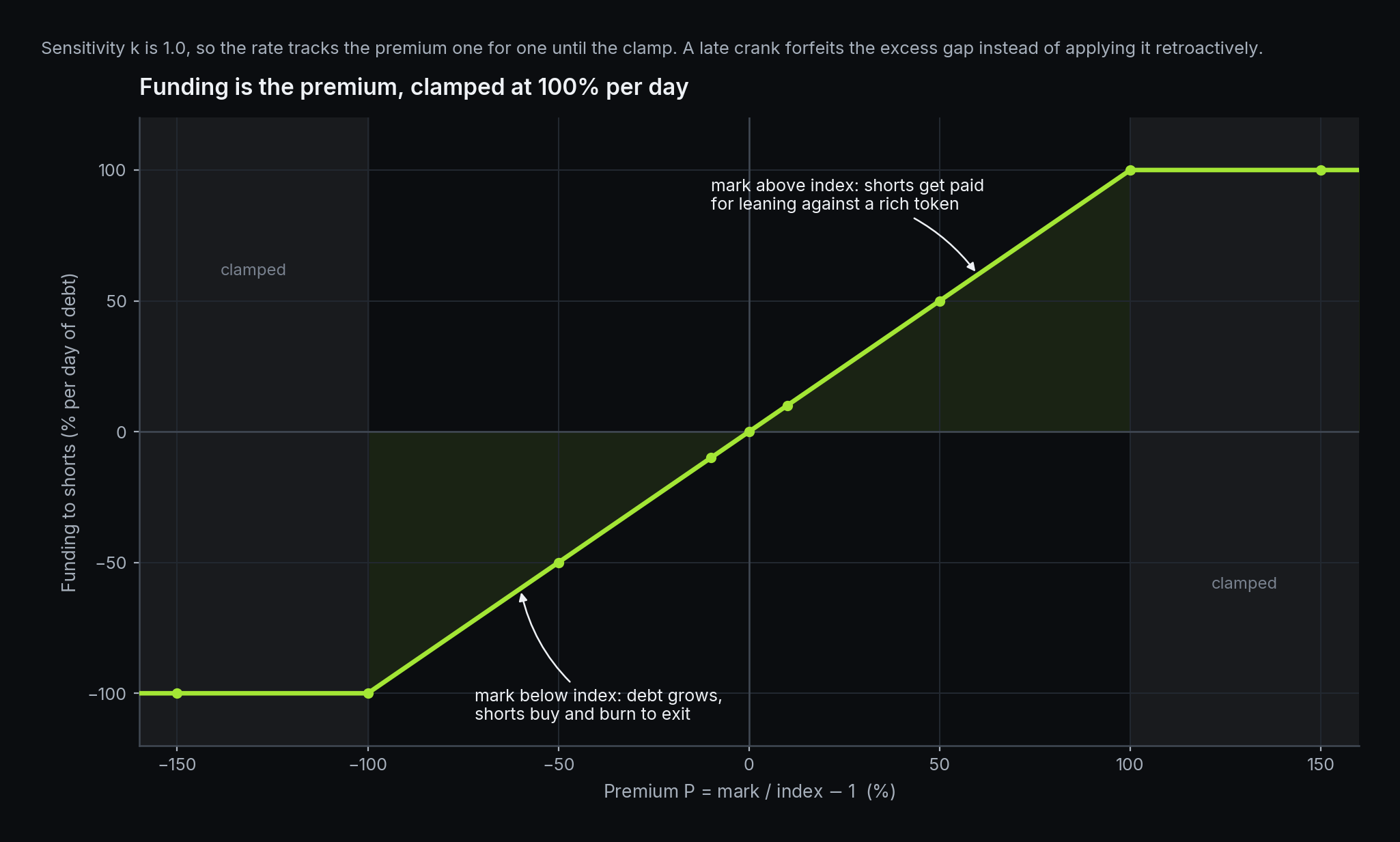
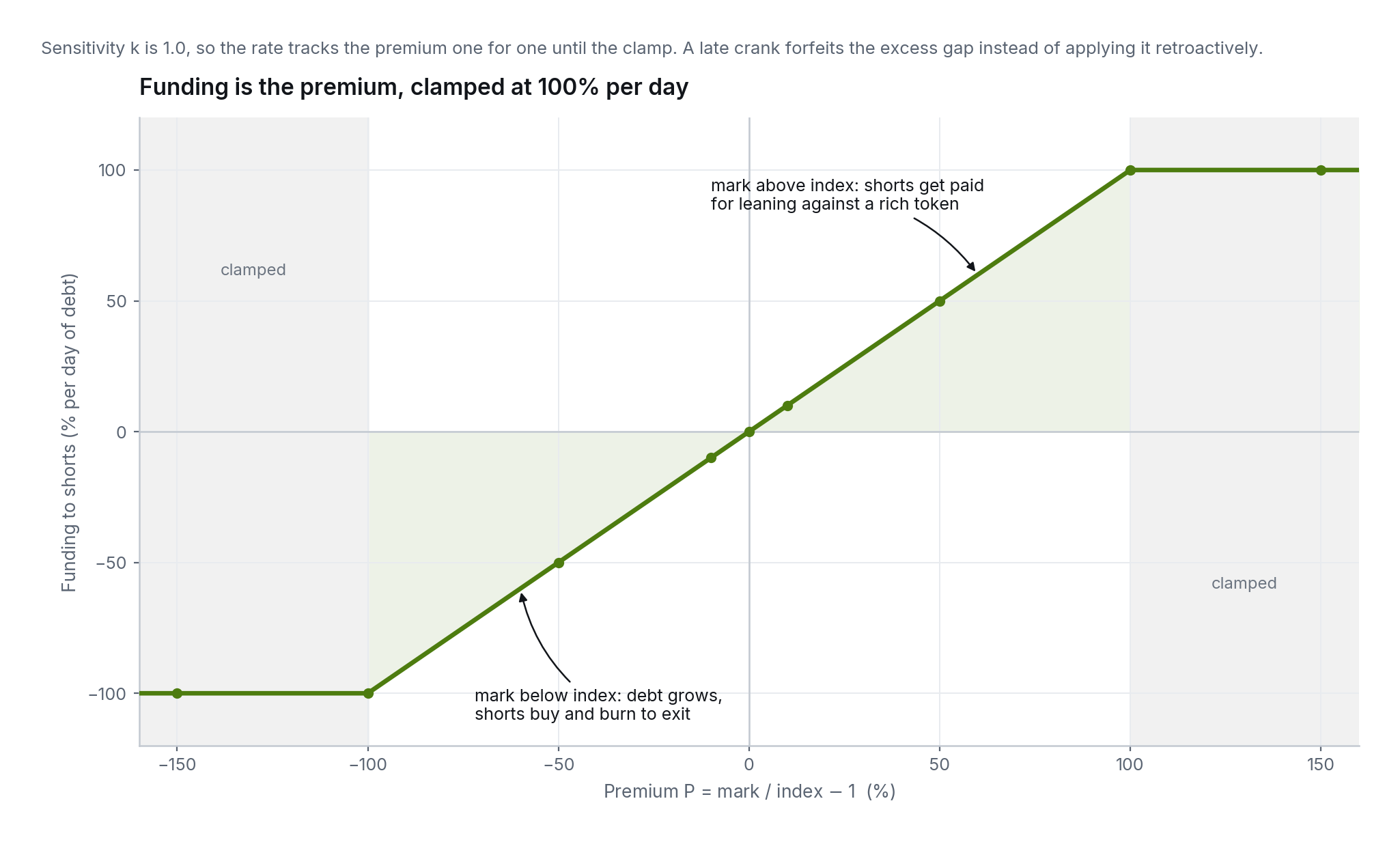
Funding rate versus premium, clamped at 100 percent per day.Funding rate versus premium, clamped at 100 percent per day.

Funding rate versus premium, clamped at 100 percent per day.

The rate

Funding compares the mark price (an EMA, never spot: fed by the internal AMM on internal-venue markets and by the oracle-pushed push_mark on external-venue markets; see AMM) to the index TWAP:
funding_k_bps is the sensitivity: at 10000 the daily rate equals the premium one for one (before the clamp). The clamp is the hard bound; no matter how large the premium prints, funding cannot move faster than max_funding_bps_per_day.

How it is applied

Anyone can call accrue_funding (a permissionless crank), rate-limited by min_crank_interval_secs and gated on index freshness (a market past max_index_age_secs without a push returns IndexStale; funding must never accrue against a price the oracle stopped standing behind, see the staleness guard). The crank:
  1. Refreshes the mark: from the current AMM reserves on internal markets; on external markets it instead requires a pushed mark to exist (NoMark) and to be fresh within max_index_age_secs (IndexStale).
  2. Computes the clamped rate above.
  3. Applies it, pro-rated by elapsed time, to the market’s global funding_index (a fixed-point multiplier, FUNDING_ONE = 1e12).
The elapsed time in step 3 is capped at one day per crank. A crank that arrives late forfeits the excess interval instead of applying the current premium retroactively to an unbounded gap, and the cap also guarantees the linear step can never zero the funding index (an uncapped day-plus gap at the full clamp could have, permanently bricking funding; fixed in the 2026-07-24 adversarial review). Every short position stores its debt divided by the funding index at touch time, so a single update to funding_index reprices all debt at once. See Shorts for the exact scaling.

Direction

Together with reserve draw/repay arbitrage (drawing at the index is profitable when the mark is rich; repaying at the index is profitable when the mark is cheap), this pulls the mark toward the index from both sides.
The tether is soft. Funding drifts the price toward the index; it does not pin it there. Expect a persistent basis of a few percent in normal conditions, wider in stressed ones.

Where funding settles in v1

v1 applies funding purely as a debt adjustment on shorts, with the insurance fund as the system backstop at liquidation time. Token holders are not directly charged or paid; their side of the flow is implicit in the arbitrage pressure on the mark. A staked long pool that explicitly receives and pays funding is planned for v2 (see Roadmap).

Why the clamp matters for security

Because there is no oracle-priced redemption, a manipulated index print cannot drain a pool. The worst it can do is tilt the funding flow, and the clamp bounds that tilt:
A manipulator must also keep the bad print alive across the index TWAP window while the circuit breaker watches for deviation, and total short debt is bounded by the finite hedge reserve. The result is that oracle manipulation is a bounded, slow leak rather than an event. This property is the reason commas can reference thin external markets at all.