

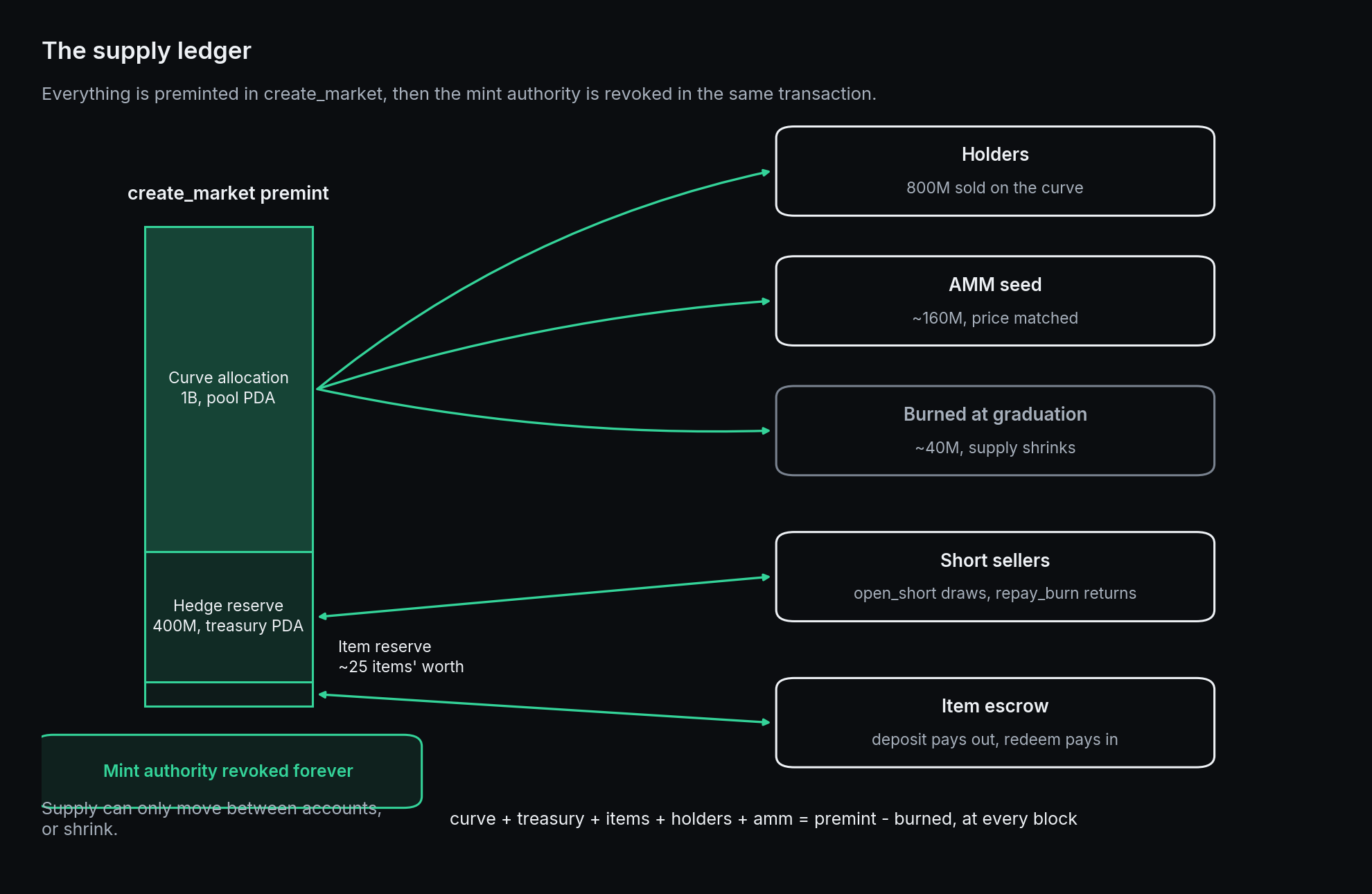
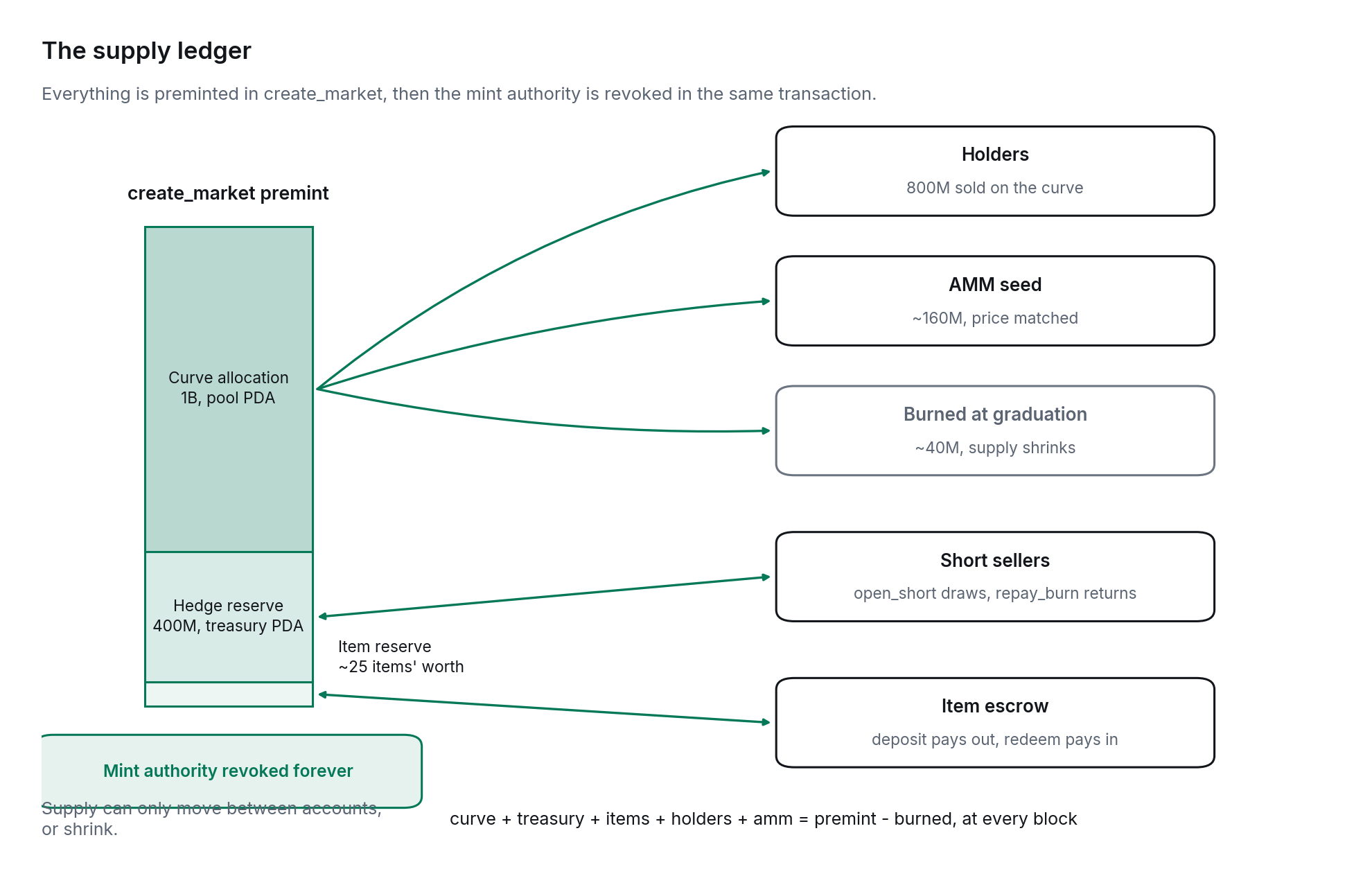
The supply ledger: preminted once, then only moves or shrinks.
Fixed supply, mint revoked
Every commas token is a fixed-supply SPL token with a revoked mint authority, on both venues. On the internal venue:- The mint lives at a program-derived address (seeds
["mint", market]), so each market has exactly one deterministic mint address; see PDAs. create_marketpremints the entire allocation in the creation transaction: the curve allocation (curve_virtual_tokens) into the pool account, the hedging reserve (max_open_interest) into the treasury, and the item-swap reserve (item_reserve, when configured) into the item reserve account, then permanently revokes the mint authority (SetAuthorityto none). Wallets and screeners show the mint as revoked from the first block.- Nothing can ever mint again. After creation, tokens only move between accounts, and the one burn in the system (unsold curve allocation at graduation) means supply can only shrink.
- Decimals: 6.
Market.synth_mint; supply is likewise fixed and the program holds no mint authority. See What backs each tranche below and Venues.
The hedging facility is a preminted supply allocation, like a locked reserve in any launch’s tokenomics. It is not an inflation mechanism: drawing from it moves existing tokens into circulation, and repayments move them back out.
Unit math
The scale constant for every market:625_000_000 lamports per unit, and one card equals ten units at launch (units_per_item_micro = 10_000_000; see item swaps). If the card doubles, the pushed index doubles to 1.25 SOL per unit and one token (1e6 base units) is worth 1.25e9 * 1e6 / 1e12 lamports, or 0.00000125 SOL. The million-to-one split keeps the per-token price in memecoin territory; the launch scaling keeps every market’s unit on the same footing regardless of how expensive the collectible is.
Where circulating supply comes from
Total supply is fixed at creation; what moves is how much of it circulates. Every path is a transfer between program accounts and wallets:
AMM swaps move existing tokens between the pool and traders; nothing in the live market changes supply.
Both venues run the identical CDP path:
open_short draws from ["treasury", market], while repay_burn and liquidate return tokens to it. The treasury balance is the market’s physical open-interest ceiling (TreasuryDepleted). On the internal venue the reserve is preminted at creation; on the external venue it is funded by a plain SPL transfer at listing time.
Post-graduation supply on the internal venue is exactly:
What backs each tranche
The circulating supply has three economically distinct tranches:- Curve and AMM supply: tokens sold on the curve plus the graduation pool seed. These are backed by the SOL sitting in the market vault (the raise and the AMM reserve), like any launchpad token. Sellers exit against that SOL through the pool.
- CDP supply: tokens drawn from the treasury reserve by
open_short. Every one of these is backed by a specific shorter’s SOL collateral at no less thaninitial_cr_bps(150% by default) of index value at draw time, defended by liquidations belowmaintenance_cr_bps. - Item-swap supply: tokens released from the item reserve by
deposit_item. Every batch entered circulation against a real copy of the underlying that now sits in the market’s escrow, and anyone can reverse the trade by returning equal value in tokens for a copy.
The tranches are fungible in your wallet; a token does not know which path released it. The distinction matters for reasoning about system solvency: CDP supply has a named debtor who must buy it back or be liquidated, curve supply does not.
Item swaps
A market’s liquidity is not limited to SOL: the collectible’s own supply is liquidity. When a market is backed by “Pikachu PSA 10”, every vaulted copy of that card+grade can enter the market. A holder deposits their on-chain copy (a vaulted-card NFT, or a collection NFT for floor markets) and receives tokens; any token holder can do the reverse and walk away with a copy. Both directions are value-based, never a fixed per-item token count:units_per_item_micro restores the item’s real size: how many units one physical item was worth at launch, in millionths (card_index_at_launch / 0.625 SOL). The numerator is then what one copy is worth at current prices and the denominator is what one token trades for (the mark EMA). You always exchange one item for tokens of equal market value at that moment:
- Token trading at its index parity: one copy swaps for about
units_per_itemunits of tokens. - Token trading at half the index (mark EMA at 50% of parity): one copy swaps for about twice that, because each token is worth half as much. The value received is identical.
- Only registered copies are accepted.
register_itemcreates anItemRegistrationPDA per (market, item mint); registration is admin-gated in v1 while the relayer verifies vault provenance off chain. - Deposited copies sit in a market-authority escrow (one ATA per item mint);
Market.items_depositedcounts them andItemSwappedfires on every swap. See Events. - Deposit tokens come from the item reserve (
["items", market]), a third preminted allocation sized byparams.item_reserveat creation, so supply stays fixed.ItemReserveDepletedbounds the facility exactly like the treasury bounds shorts; withdrawals refill the reserve. A market created withitem_reserve = 0has no item facility, and creating one withitem_reserve > 0requiresunits_per_item_micro > 0(ZeroAmountotherwise). The launch executor sizes the reserve for 25 deposited items at launch scale. - Both directions work in either phase, curve or AMM: during Bootstrap the mark EMA is seeded at the curve’s opening price and stepped by every curve trade, so a copy can be deposited from the first block. The market must be unfrozen with a fresh index and a nonzero mark.
min(dt, window)/window per block, so a single-transaction price spike barely moves the swap rate. The same smoothing that protects funding protects item swaps.
What this does to the market. The swap is deliberately value-neutral in SOL terms: at execution you always give and receive equal value, so depositing or withdrawing is not itself an arbitrage against the pool. What it adds is a physical entry and exit. A holder converts a copy into liquid tokens at fair value without a marketplace sale, and while escrow holds copies, any token holder can convert index-referenced exposure into the real thing. The token stops being a pure reference to the card’s price and becomes, up to escrow inventory, convertible into it.
Why the reserve valve matters
The treasury paths are the price tether’s muscles. When the synth trades above the index, drawing new circulating supply from the reserve at index value viaopen_short and selling it is profitable, which adds circulating supply and pushes the price down. When it trades below, shorts buy back cheap and repay_burn, which pulls supply out of circulation and pushes the price up. Funding pays whichever side the tether needs more of.
The reserve, sized at creation (internal venue) or funded at listing time (external venue), bounds how much tether pressure the market can exert. When it is empty the facility is full: that is the open-interest ceiling enforced by arithmetic. See Parameters.