

The v1 relayer is built and lives at
relayer/ in the repository (TypeScript, run
with npm run once for a single cycle or npm start for the loop). The full stack was
exercised end to end against live Mad Lads data from Magic Eden
on 2026-07-23: the relayer estimated and pushed the index, then the market ran curve
launch, graduation, AMM trading, a hedger short, and funding accrual against it. On
2026-07-24 the card pipeline did the same live: Umbreon VMAX Alt Art (swsh7-215, RAW,
$2,137.76 on TCGplayer) landed on chain at 28.32 SOL through a live Pyth SOL/USD read,
within 2 bps of source, and the Meteora DAMM mark source was verified against a live
SOL-paired pool. Source coverage still grows over time; per-pipeline status is noted
on the card pipeline and NFT pipeline
pages.Overview
Every commas market prices its synthetic against an index: the current market value of the collectible (a graded card, a basket of cards, or an NFT collection floor), expressed in lamports per whole unit. That index does not exist on any chain. The relayer is the market’s price feed: a service commas runs that reads the collectible’s real prices from marketplaces (eBay and TCGplayer aggregates, Collector Crypt, Magic Eden), filters manipulation, and writes the result on chain with a signature the program trusts.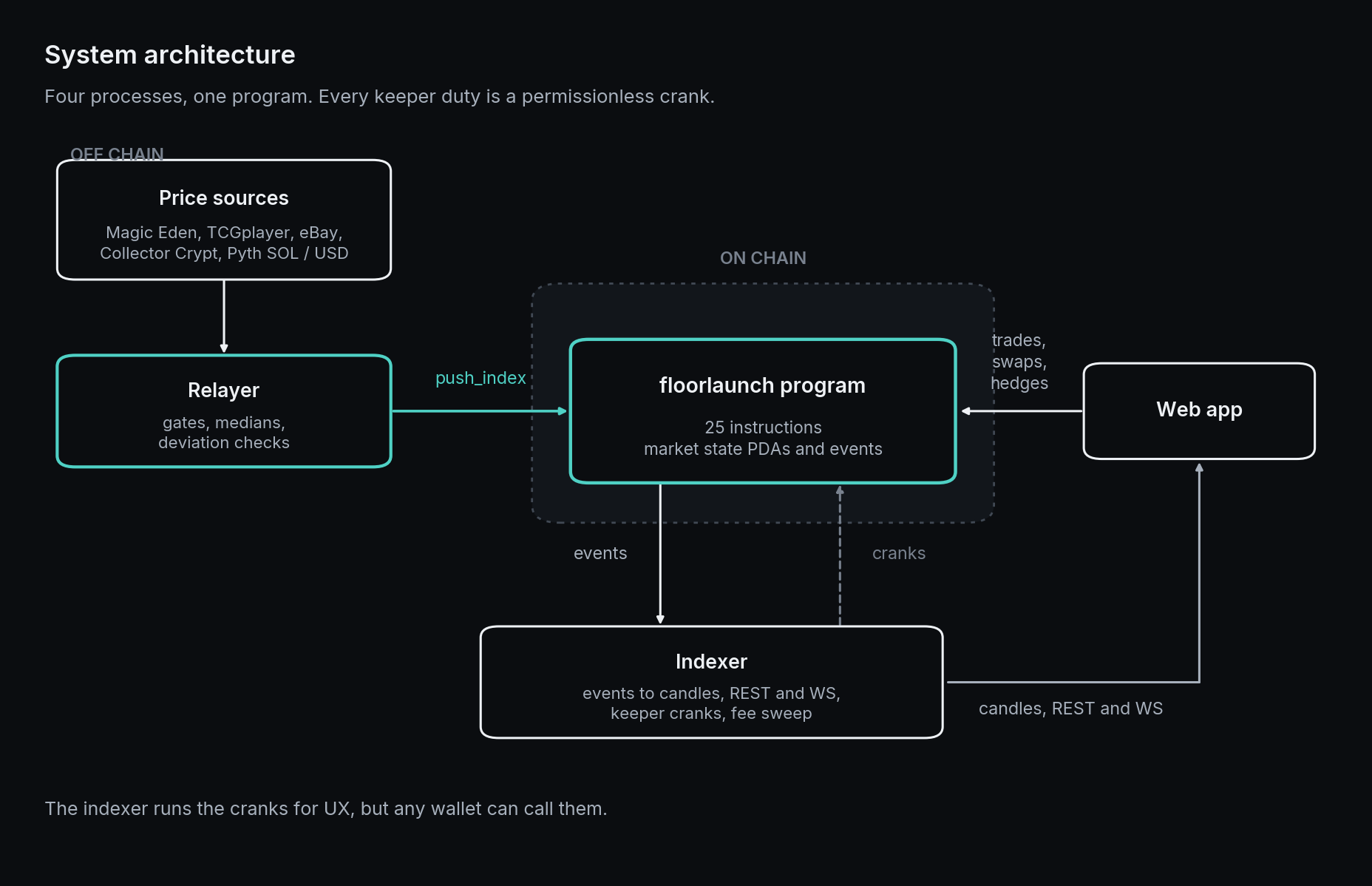
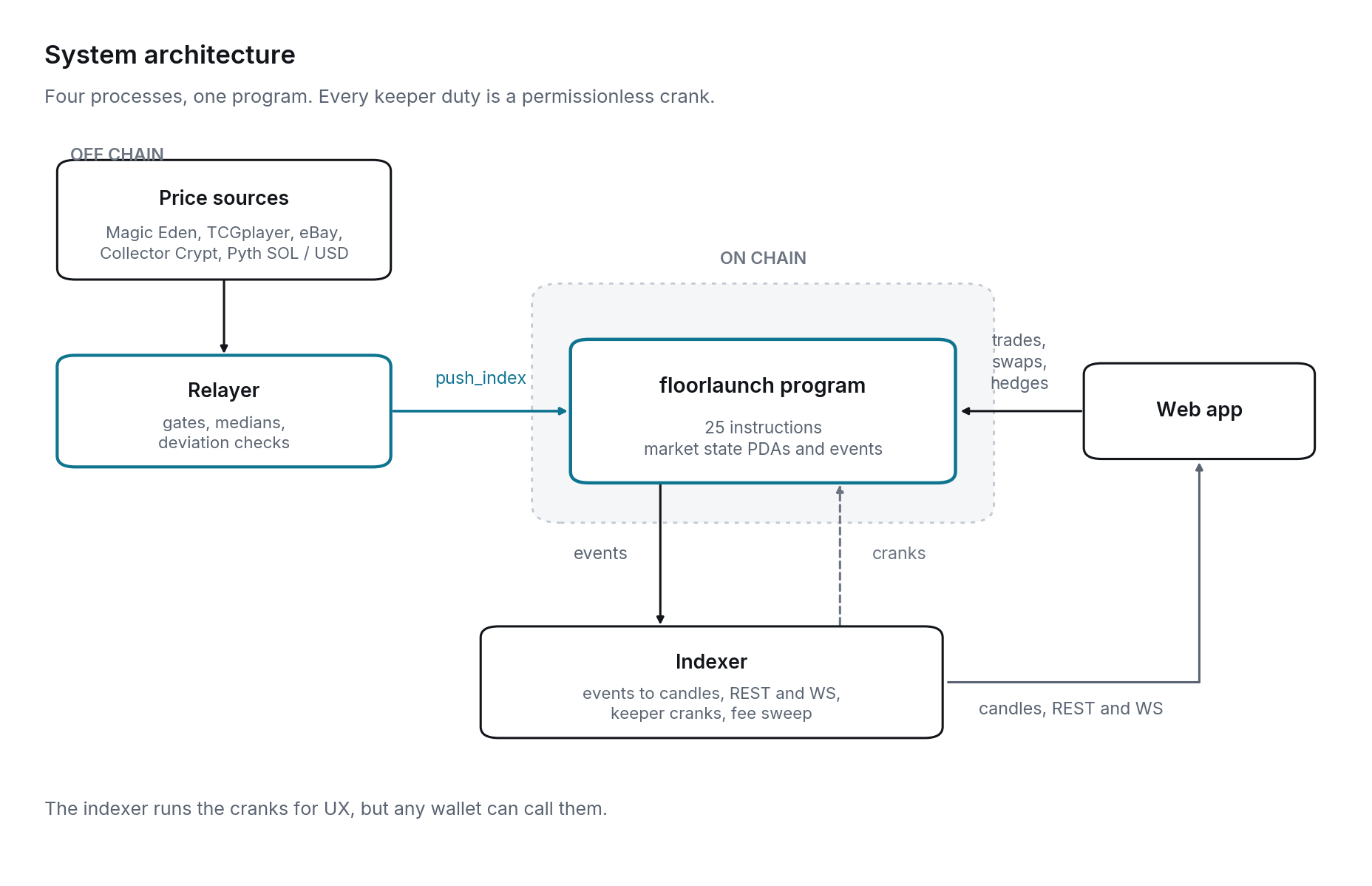
The system: sources, relayer, program, indexer, app.
- holds the oracle authority keypair (the only key the program accepts for
push_indexandpush_mark), - reads a per-market config mapping each market’s address to an underlying spec (which card, which grade, which sources, which gates),
- runs a fetch, estimate, gate, convert, push cycle for every configured market, typically hourly.
create_market.
The config is a YAML file (see relayer/config/relayer.example.yaml):
The cycle
For each market, each cycle:- Fetch raw data from every configured source (sale prints, bids, asks, marketplace quotes). Sources differ per asset class; see the card pipeline and NFT pipeline.
- Estimate a single fair value in USD (cards) or SOL (NFT floors) using recency-weighted medians with outlier rejection.
- Gate the estimate. If sources disagree too much, or there is not enough underlying trade activity in the window, the relayer does not push. It holds the last value and raises an alert instead.
- Convert to lamports per unit. Dollar-denominated estimates go through a Pyth SOL/USD read.
- Push a signed
push_index(price_lamports)transaction for the market. - External-venue markets only: additionally compute the mark price from the
configured Meteora DAMM pool (reserve amounts from Meteora’s public API; the pool
must be a synth/WSOL pair) and push it with
push_mark. The on-chain program never parses external pool bytes; the mark enters through the same oracle-signed, EMA-smoothed, funding-clamped path as everything else. See Venues.
Defense in depth: what the chain adds
The relayer is a trusted component, but the program is designed so that trust is bounded. A pushed price passes through four on-chain defenses before it can affect anyone’s position:
There is no instruction anywhere in the program that redeems or pays out third-party
funds at the oracle price. A bad print can tilt funding and shift collateral-ratio
checks; it cannot drain a pool.
Pushes as heartbeat
The relayer pushes every cycle even when the price is unchanged. Each accepted push updatesindex_last_ts on the market account, which both drives the on-chain
staleness guard and lets anyone (UIs, bots)
read exactly how fresh the index is. A market whose index_last_ts is hours old is
visibly stale, and past max_index_age_secs it stops being trusted at all.
See Operations for key handling, alerting, and failure behavior.